
NASA's spacecraft will investigate indications of life on Europa, one of Jupiter's moons.
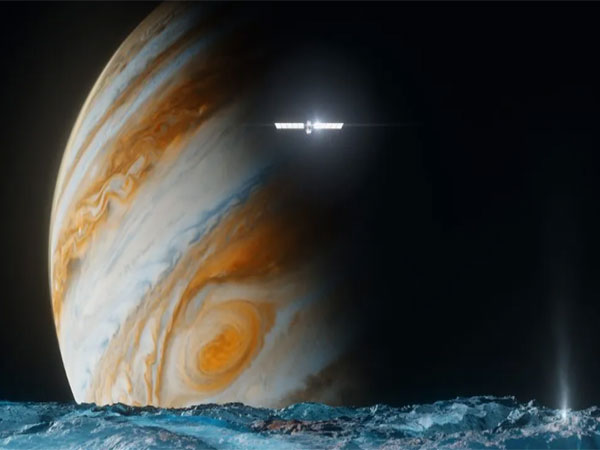
Florida [US], October 14: A spacecraft is scheduled to launch on Monday from the Kennedy Space Center, aiming to explore signs of alien life on Europa, one of Jupiter's moons.
Previous research indicates that beneath Europa's frozen surface lies a vast saltwater ocean that could potentially harbor life forms.
"We're embarking on a 1.8-billion-mile journey to an ocean world—Jupiter's moon, Europa!" the US space agency NASA stated this morning on X in anticipation of the upcoming launch.
NASA's Europa Clipper mission, the agency's largest spacecraft developed for a planetary exploration, was initially set for launch earlier but was delayed due to Hurricane Milton, which impacted Florida on October 9-10.
Both the Europa Clipper and the SpaceX Falcon Heavy rocket were secured inside a SpaceX hangar near their launch pad at NASA's Kennedy Space Center, according to agency officials on X.
The probe is expected to cost around USD 5.2 million.
After its launch, the spacecraft plans to fly by Mars in February 2025 and then pass by Earth in December 2026, using the gravitational pull of each planet to gain speed. These "gravity assists" will allow the Europa Clipper to reach the necessary velocity to arrive at Jupiter in April 2030.
Earlier, on April 14, 2023, the European Space Agency launched the Jupiter Icy Moons Explorer (Juice) mission from its spaceport in French Guiana to study Jupiter and its three large ocean-bearing moons—Ganymede, Callisto, and Europa. Juice is expected to reach Jupiter by July 2031.
The Europa Clipper spacecraft will travel 1.8 billion miles (2.9 billion kilometers) to arrive at Jupiter in April 2030. It will orbit Jupiter and perform 49 close flybys of Europa.
During these flybys, the spacecraft's nine scientific instruments will gather data on the moon's atmosphere, ice crust, and the underlying ocean.
The nearly 10-feet-wide (3-meter) dish-shaped antenna and several smaller antennas will transmit data back to Earth, with the communication taking about 45 minutes when the spacecraft is in orbit around Jupiter, NASA stated.
The antenna will operate using NASA's deep space X-band radio frequencies through the agency's Deep Space Network, a global array of large radio antennas that communicate with numerous spacecraft across the solar system.
"Although Europa Clipper is not a life-detection mission, understanding Europa's habitability will help us gain insights into how life developed on Earth and whether we might find conditions that could support life beyond our planet," NASA noted.
The instruments aboard the Europa Clipper include cameras, spectrometers, a magnetometer, and ice-penetrating radar. These tools will investigate Europa's icy shell, the ocean below, and the composition of gases in the moon's atmosphere and surface geology, providing valuable information about its potential for habitability.
Additionally, the spacecraft will carry a thermal instrument to identify warmer ice regions and any potential water vapor eruptions. There is strong evidence that the ocean beneath Europa's crust is twice the volume of all of Earth's oceans combined, as detailed by the US space agency.
Scientists from NASA, the Jet Propulsion Laboratory, and the Johns Hopkins Applied Physics Laboratory are contributing to the Europa Clipper mission.
In 1610, Galileo Galilei made the first detailed observations of Jupiter using a homemade telescope.
NASA's first spacecraft to visit the outer planets, Pioneer 10, was designed for a 21-month mission to Jupiter but operated for over 30 years. After its encounter with Jupiter in 1973, it continued beyond the solar system, sending its last signal to Earth in January 2003 from a distance of 7.6 billion miles.
Pioneer 11, a sibling spacecraft to Pioneer 10, flew closer to Jupiter in 1974 on its way to Saturn. After studying Saturn, Pioneer 11 exited the solar system, carrying a plaque with a message for any intelligent beings it may encounter.
During its flyby of Jupiter in March 1979, Voyager 1 discovered a thin ring around the planet, two new moons, and active volcanoes on the moon Io before proceeding to Saturn and interstellar space.
Voyager 2 began sending images of Jupiter on April 24, 1979, creating time-lapse movies of atmospheric circulation. Unlike Voyager 1, Voyager 2 made closer passes to the Jovian moons, with scientists particularly interested in gathering more data from Europa and Io.
Later, the Galileo spacecraft orbited Jupiter for nearly eight years and released a probe into its atmosphere, becoming the first spacecraft to enter Jupiter's atmosphere.
The Cassini spacecraft captured detailed images of Jupiter while en route to neighboring Saturn, as did New Horizons during its journey to Pluto and the Kuiper Belt.
NASA's Juno spacecraft has been studying Jupiter from orbit since July 2016, probing beneath the planet's thick clouds to answer questions about its origin and evolution. Juno is scheduled to continue its investigation of the solar system's largest planet, its moons, faint rings, and surrounding environment through September 2025.